
Visualization & Technology
Model Flat vs VR Walkthrough: Cost, Reach, Flexibility & ROI for Builders
Space & Scale Studio · 2026-09-20 · 9 min read

Model flats offer a physical experience, but VR walkthroughs offer wider reach, more flexibility and stronger ROI. Compare cost, reach and sales impact for builders in 2026.
For decades, the model flat has been one of the strongest sales tools in residential real estate.
A buyer walks inside, experiences the living room, sees the kitchen finishes, understands the bedroom sizes and starts imagining life in the property.
That emotional connection is powerful.
But the way people discover and evaluate property is changing.
Today, buyers may first see a project on Instagram, receive details through WhatsApp, attend an online presentation from another city, or compare several developments before ever visiting the site.
This is where the VR walkthrough for real estate is becoming increasingly valuable.
Instead of asking whether VR will completely replace model flats, builders should ask a more practical question:
Which sales tool gives us better cost efficiency, wider reach, more flexibility and stronger long-term ROI?
The answer depends on how each project is marketed.
Model Flats Still Create a Strong Physical Experience
There is a reason builders continue investing in model apartments.
Walking through a physical space gives buyers a real sense of scale. They can physically experience the room proportions, finishes, furniture placement and overall atmosphere.
For premium developments, that experience can be extremely convincing.
But a model flat also comes with limitations.
Usually, one model flat represents one apartment configuration.
If a project contains 2BHK, 3BHK, 4BHK and penthouse units, creating a physical model apartment for every configuration can become expensive and space-intensive.
Any major change in finishes, furniture or design may also require physical modification.
And most importantly, the experience is available only to buyers who actually visit the sales office.
That is where digital visualization starts offering a very different advantage.
What Changes With a VR Walkthrough?
A VR walkthrough allows buyers to virtually enter a property before it is physically constructed.
Instead of looking at only floor plans or static images, buyers can experience the living room, kitchen, bedrooms, balcony and other spaces at a realistic scale.
With good architectural visualization, developers can create experiences for multiple apartment types within the same project.
A buyer interested in a 2BHK can explore one layout. Another buyer can immediately switch to the 3BHK. A premium buyer can experience the penthouse.
The builder does not need three different physical model apartments to demonstrate them.
This makes a 3D walkthrough particularly useful for large residential developments with multiple unit configurations.
Model Flat vs VR Walkthrough
| Factor | Model Flat | VR Walkthrough |
|---|---|---|
| Initial setup | Physical construction and interiors required | Digital development |
| Unit configurations | Usually one or limited | Multiple configurations possible |
| Changes | Physical changes may be expensive | Digital finishes and layouts can be updated more easily |
| Buyer reach | Mainly site visitors | Site visitors + remote buyers |
| Pre-launch use | Limited until physical space is ready | Can be created before construction |
| NRI buyers | Difficult to experience remotely | Can be demonstrated digitally |
| Sales presentations | Mainly sales-gallery dependent | VR, display screens, laptop presentations and digital campaigns |
| Reusability | Connected to physical location | Can be reused across multiple marketing channels |
The biggest difference is therefore not simply physical versus virtual.
It is one fixed experience versus one adaptable digital sales asset.
The Biggest Advantage: Selling Before Construction Is Complete
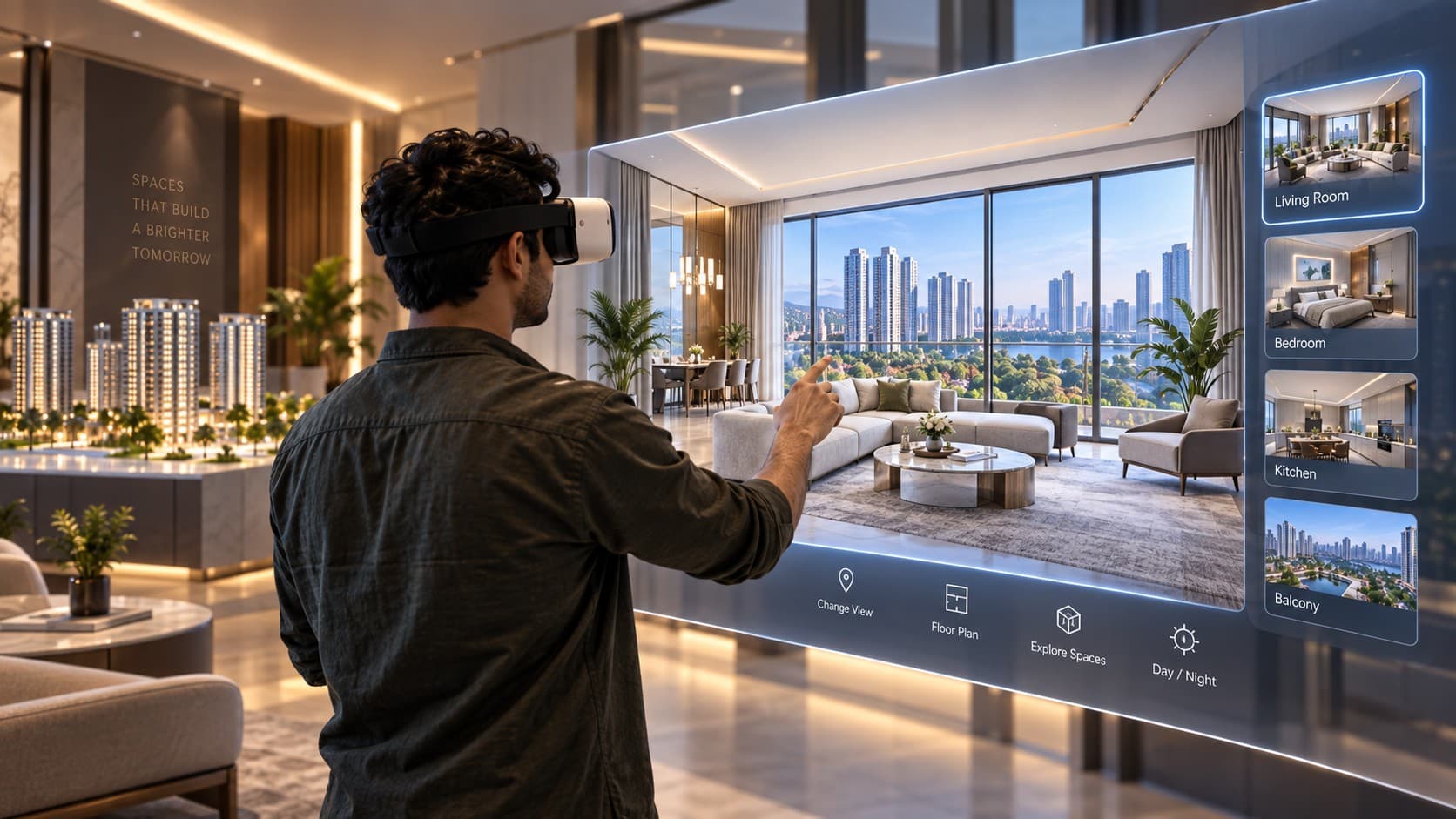
One of the most valuable applications of VR in real estate is during pre-launch and early construction.
Buyers are often expected to make a major financial decision when very little of the final project physically exists.
They may be shown floor plans, brochures and architectural renders.
These are useful, but many buyers still struggle to understand the actual spatial experience.
How large will the living room feel? What will the balcony view look like? How does the dining area connect to the kitchen? Will a particular bedroom comfortably accommodate the expected furniture?
A well-designed 3D architectural walkthrough helps answer these questions visually.
The buyer is no longer trying to mentally convert a 2D floor plan into a home. They can experience the proposed space.
One Experience Can Reach Buyers Beyond the Sales Gallery
A model flat works extremely well when the customer is physically present.
VR and real estate visualization can extend that sales experience beyond the site.
Imagine an NRI buyer interested in a property in Hyderabad. Instead of waiting until their next visit to India, the sales team can demonstrate the property digitally during an online meeting.
A sales executive at another location can also present the same development.
Selected visual content can be adapted for websites, social media, presentations and WhatsApp communication.
The visualization investment therefore supports more than one sales interaction. It can become part of the project's wider marketing ecosystem.
Buyers Can Compare More Than Just Apartment Sizes
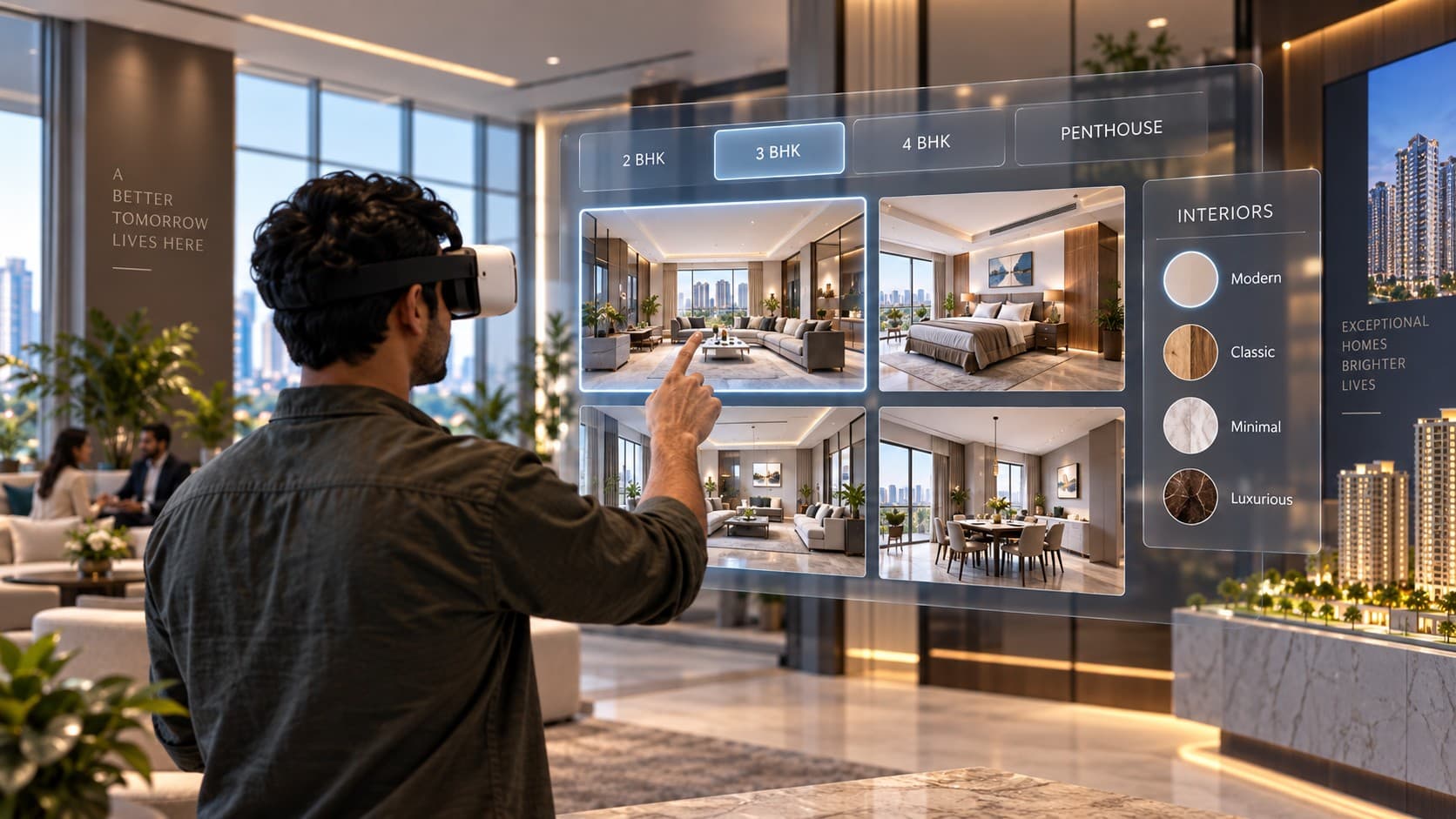
Another advantage of digital visualization is customization.
Suppose a buyer likes a 3BHK layout but wants to understand how different interiors may look.
Instead of creating multiple physical interiors, a digital experience can demonstrate different possibilities: modern interiors, warmer finishes, alternative flooring, different kitchen finishes, day and night environments, different furniture arrangements.
The purpose is not to give buyers unlimited options. It is to help them understand the potential of the space more clearly.
This can be particularly effective for premium developments where presentation plays an important role in perceived value.
What About Cost?
A model flat and a VR walkthrough should not be compared only by their initial price.
Builders should consider how many buyers, configurations and marketing activities the investment can support.
A physical model apartment requires space, civil work, furniture, interiors, lighting, maintenance and future modification. For one premium apartment type, that investment may make perfect sense. But when several configurations need to be demonstrated, costs can rise quickly.
A VR walkthrough requires an upfront investment in 3D rendering, architectural visualization and interactive development, but the same digital environment may support multiple unit types and repeated presentations.
That is why ROI should be measured across the entire sales cycle rather than only by comparing setup costs.
Should Builders Stop Creating Model Flats?
Not necessarily.
For many projects, the strongest strategy may actually be a combination of both.
A physical model flat can provide the tactile experience buyers appreciate. VR can then expand what the physical sales gallery cannot show.
The customer may physically experience the 3BHK model flat and then use VR to explore the 2BHK, 4BHK, penthouse, clubhouse, amenities or different design options.
In this approach, VR does not replace the sales experience. It expands it.
Where VR Can Deliver the Most Value
VR becomes especially useful for builders launching projects with several unit types, premium developments, projects under construction and developments targeting buyers outside the immediate city.
It can also help developers who want their sales presentation to communicate the quality of the project before the final property exists.
For competitive markets such as Hyderabad, presentation increasingly matters because buyers often compare several projects before making an enquiry or scheduling a site visit.
Better visualization does not replace a good location, sensible planning or strong pricing. But it can help buyers understand those advantages much faster.
The Real Question Is Not Model Flat or VR
The more useful question for builders is:
How can we help buyers experience the project earlier, understand it faster and remember it better?
A model flat answers that question physically. A VR walkthrough answers it digitally and at a much wider scale.
For builders who want to present multiple apartment configurations, reach NRI buyers, strengthen pre-launch marketing and create reusable sales content, architectural VR can become far more than a presentation tool.
It becomes part of the project's sales infrastructure.
Building a Project in Hyderabad?

At Space and Scale, we create architectural visualization, 3D walkthroughs and VR walkthrough experiences in Hyderabad that help builders present upcoming projects before construction is complete.
From apartment interiors and multiple unit configurations to amenities and complete project experiences, our goal is simple:
Help buyers experience the property before they buy it.
Because in real estate, seeing a plan explains the project.
Experiencing the space can sell it.